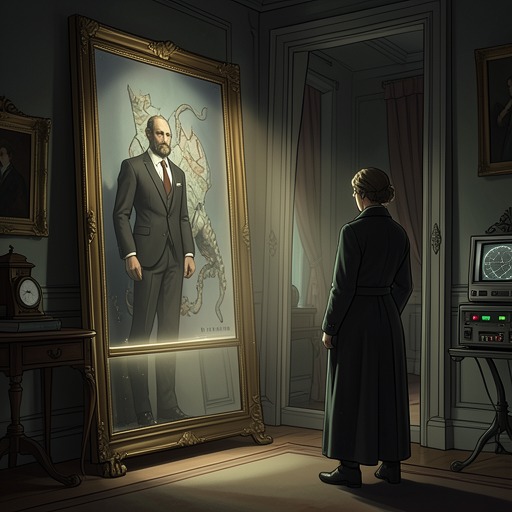
Theodorus Van Spee
The Portable DoorTheodorus Van Spee is a senior wizard at J.W. Wells & Co., known professionally as Professor Van Spee and regarded by Dennis Tanner as one of the leading practitioners in private-sector magic. His scenes make expertise feel as unsettling as it is impressive: he introduces himself to Paul Carpenter with a crushing handshake, watches an apparently blank wall, and delivers a startlingly detailed account of Sophie Pettingell’s private habits. An old photograph then places the same recognizable man in 1891, deepening the mystery around his history without explaining it.
Identity and Standing at J.W. Wells & Co.
When Paul is first given instructions about the office’s hierarchy, Dennis Tanner distinguishes Van Spee from ordinary staff by insisting that he be addressed as Professor Van Spee or simply Professor. The formality is one of several rules for navigating the company’s senior figures, and it marks Van Spee as a person whose title carries weight. Tanner himself later describes him as probably the best wizard currently working in the private sector.
Van Spee’s credentials appear in the firm’s list of partners and senior personnel as VULWIT. Tanner cannot recall what the initials stand for, but explains that they signify Van Spee’s professorship of witchcraft at the University of Leiden. The uncertain expansion of the credential contrasts with the confidence of Tanner’s assessment: whatever the letters mean, Van Spee’s standing in the trade is substantial.
Tanner also outlines the breadth of his work. Van Spee specializes principally in space-time matters and consultancy, and is responsible for the firm’s information-technology side. This places him at the intersection of magical knowledge and the company’s practical operations. The description establishes his range of expertise, though the episodes shown do not depict him performing a space-time spell or directly managing a particular technology project.
A Disquieting First Encounter
Van Spee approaches Paul while Paul is collating office papers. Tall and thin, he is bald apart from clumps of white hair above his ears; his long-fingered hand is liver-spotted, his fingernails bitten, and a thin silver ring sits on his middle finger. He sounds both annoyed and nervous as he identifies himself, although he has apparently met Paul only at the interview. Paul remembers that Van Spee prefers his professorial title, and finds the older man’s grip unexpectedly powerful, like a scrapyard car-crusher.
The encounter is made stranger by where Van Spee directs his attention. He repeatedly looks over Paul’s shoulder at a blank wall, as if expecting something to appear there. Paul notices but resists turning around to inspect it. The unexplained gaze gives the office’s ordinary workroom an atmosphere of concealed activity, while Van Spee’s calm, matter-of-fact manner offers no explanation for what he may be watching.
His conversation shifts abruptly from reassurance about the new employees to an intensely specific account of Sophie, who is not in the room. Van Spee knows that she has a birthmark above her navel, that her rabbit Lucky died nine years earlier, and that she likes Cadbury’s Creme Eggs despite being reluctant to admit it. He advises Paul against flowers and recommends, as possible presents, a short wool scarf or a good-quality pocket calculator. The precision of the details is matched by their range: he describes Sophie’s reading, eating, finances, dancing, dislikes, anxieties, and the way she reads Paul’s thoughts from his face.
Some of this knowledge is framed as practical advice, but its intimacy makes the guidance unsettling. Van Spee warns Paul away from peppermint before a kiss and cautions him not to pretend to be someone else in order to impress Sophie. He also advises care around her sensitivity about her appearance, Birmingham, and money. The scene never identifies how he acquired these details, so his knowledge remains an unresolved feature of his characterization rather than an explained power.
Sophie, Paul, and the Uncanny Office Routine
Van Spee’s unsolicited counsel has an immediate effect on Paul. Paul listens in a trance-like state, then checks the page Van Spee has identified as out of sequence. The fifth page from the bottom belongs third from the top, and Paul moves it accordingly. A personal intervention in Paul’s potential relationship with Sophie thus gives way to an exact instruction about routine paperwork. In both cases Van Spee speaks with confidence about matters Paul has not yet noticed or understood.
When Sophie returns, Paul says that Van Spee has just been there and asks whether she knows him from somewhere else. He pretends to have forgotten the professor’s name, prompting Sophie to supply it; she says she had never seen him before the interview. Her answer does not resolve how Van Spee knows so much about her. Instead, the exchange sharpens the contrast between the professor’s exhaustive familiarity and Sophie’s claim of little prior acquaintance with him.
Van Spee also appears in the firm’s assessment of the two new employees’ abilities. Dennis Tanner tells Paul that Van Spee considers Sophie to have the potential to become a seer, and presents the judgment as a serious compliment. Sophie is not persuaded to pursue that possibility: she says she is honoured but does not want to. Van Spee’s expertise therefore reaches beyond his own portfolio in the form of professional evaluation, while Sophie retains the choice to reject the path he sees for her.
The 1891 Photograph and Van Spee’s Narrative Mystery
Later, while Paul and Sophie inventory the strongroom’s stored property, they encounter an old photograph with no name or reference number in the earlier catalogue. It is sepia-toned and cracked along a fold, bears the name of a West End photographer, and is dated 1891. The pictured man wears a top hat and frock coat and holds a black lacquered walking stick and white cotton gloves. Paul immediately recognizes him as Van Spee and knows what to enter in the Property Of column.
The image makes Van Spee’s history a concrete mystery. It associates a man encountered as a current company partner with a photograph from more than a century earlier, but the evidence does not explain whether the resemblance has a supernatural cause, how long Van Spee has lived, or how the photograph came to be stored among the firm’s property. Its lack of a catalogue attribution also leaves the connection for Paul to make by recognition rather than by an archival label.
Taken together, the wall he watches, the page he correctly identifies, his detailed knowledge of Sophie, his professional judgment of her potential, and the old photograph establish Van Spee as a figure whose authority exceeds what the surrounding characters can readily account for. He is at once a senior specialist within the company and one of its most conspicuous enigmas: his expertise is stated plainly, while the basis and history of that expertise remain open.